Croatian Genealogy Newsletter
Issue No. 26, 2017
The summer of 2016 saw two new book launches that focus on regional Croatian genealogies.
July witnessed separate gatherings for the launch of Ivo Saganic's Naši Stari Vidošcani
and Gordana Pavokovic's Ilovik i Sveti Petar adding to a growing list of genealogical sources
for the
Croatian islands.
The two new books were unveiled on different days on two different Croatian island. First presentation
occurred on July 10th in Martinšcica on the island of Cres where Saganic's book about Vidovci was showcased,
followed two weeks later by Pavokovic's book about Ilovik on the island of the same name.
Both volumes are large at 24 by 30 cm. ( 9 1/2 by 12 inches). Saganic's book is also voluminous at
512 page, while Pavokovic's book has 283 pages.
Click on the Current issue links to read more.
Current issue:
Subject and Location Index
Past Issues
Books: within Croatia
in diaspora
Croatian Genealogy: Primer
Naši Stari Vidošcani
On his seventieth birthday in 2016 Ivo Saganic launched the book which he self-published and which
was a product of ten years of research. The village of Vidovici is his ancestral families native home.
Vidovici sits nestled on a hilltop overlooking the port town of Martinšcica, similar to Lubenice
a prominent landmark which towers over the sea only a few miles north of here.
Vidovici is one of several dozen communities that had existed on the island of Cres, most small,
some would say tiny settlements, that have declined for the last few decades. Vidovici is one of
these hamlets that had a population of 150 in its heyday, but now contains only two inhabitants year round.
Capt. Ivo Saganic had a maritime career that spanned over 47 years, with 37 years as a ship's captain.
He had completed four years of maritime training in 1965 after which he worked for the Jugolinija
company going to Israel, Japan, and North America. In the last 12 years of his career he was captain
of liftboats working in the Nigeria oil fields for the American companies Halliburton and Hercules Offshore.
Saganic is now retired and resides in Martinšcica.
Saganic's parents came from Vidovici and the had a long ancestal lineage originating in the town.
Saganic grew up in Martinšcica but wrote about the families which had lived in Vidovici.
Beginning 30 years ago, Saganic wroted down his family tree information as told
to him by his father, Ive, from memmory. Later in 2006, he began his extensive research by examining
the church census records -- the Status Animarum -- for Vidovici which then led him to examine the parish
records of all the nearby communities. Saganic spent over ten years researching the families of
Vidovici, documenting individual biographies, creating family trees, outlining the history of each
house in the community, and discovering where the inhabitants moved after they left. Saganic
determined that there were 665 inhabitants of Vidovici over the last 200 years. Saganic's
launch of Naši Stari Vidošcani last July is the accumulated efforts of his work.
He presents extensive documentation of the Vidovici residents who immigrated to Youngstown, Ohio.
His research took him to the United States where he found records for 58 Vidovišcani who immigrated
to Ohio, Pennsylavania, New York, and New Jersey. Fourteen pages details this exodus to America
and include photographs of the ships on which the immigrants arrived. A detailed chart
illustrates all the residencal locations in Youngstown, Ohio for the Vidošcani who relocated there
in the first half of the 20th Century, while another chart lists all the 58 who left the village
and their dates of entry into the United States between 1893 and 1972.
The book also provides individual biographies throughout it's pages. A great amount of detail
accompanies these biographies. For example Franjo Saganic who was born in house number 2 in Vidovici
in 1887 is described in several pages with three family pictures plus a photo of the S.S. Argentina
on which he arrived in America.
All those with the surnames Saganich (Saganic), Kucich - Cucci - Cucich (Kucic)
and Stefanich - Stefani (Stefanic) in America, can trace their grandfathers, great-grandfathers or
other relatives to the village of Vidovici. Now with the aid of Sanganic's book, they can find their
family trees back 8 to 12 generations. The author excepts written communication in English
for genealogical inquiries. He states that, "It is good to know that every man in America today
that bears the name Saganich has their ancestral origins on the island of Cres dating from the
the beginning of the 20th century."
The cover of Naši Stari Vidošcani
The first inhabitant of Vidovici discovered by Saganic was Ivan Saganic, written as Zuanne Sagagnich
in the documents. Ivan was born in 1672, one of the many settlers who immigrated to the islands of Cres
and Lošinj, from neigbouring Vrbnik on the island of Krk.
The main part of Saganic's book contains chapters on each of the 27 houses which make up Vidovici. Twenty-six
of these houses today are closed during the winter. By examing the dates when these houses were in use,
one sees when specific families became established at these residences. Saganic has become the
leading authority on Saganic family origins and history. The family genealogical charts provide a
wealth of detail. Not only are the charts unique family histories stretching back, in some cases over
two hundred years, they also provide the currently living descendants of those family.
The most unique aspect of Saganic's book is its language. Most of it is written in the
Cakavian dialect of Croatian, known to the locals simply as 'Po našu' which roughly translates as 'in our own speach'.
A chapter of dialect terms is provided in the volume. For the English reader the book
is not difficult to understand even if they don't understand the language. With a list
of a few Cakavian terms, one can understand the family trees and get a rudimentary
appreciation of the biographical information. A chapter of dialect terms is provided in
the volume. However, as a concession for those who do not want to make this kind of effort
an introduction is appended in English at the front of the book, along with additional
versions in standard Croatian, Italian, and German.
The volume is a large sized publication of 512 pages and provides a detailed genealogy of all the families
that lived in Vidovici, Croatia since the beginning of the 1800s. All 27 houses in the hamlet have
their inhabitants described in biographical outlines and forms a genealogical treatise for an entire community. Saganic who was born in the hamlet,
The book which was printed in Rijeka is not known to be available in stores. Ivo Saganic handles the
distribution of his book from Martinšcica, the closest town to Vidovici. For availablity of the book
contact can be made directly with the author at:
Ivo Saganic
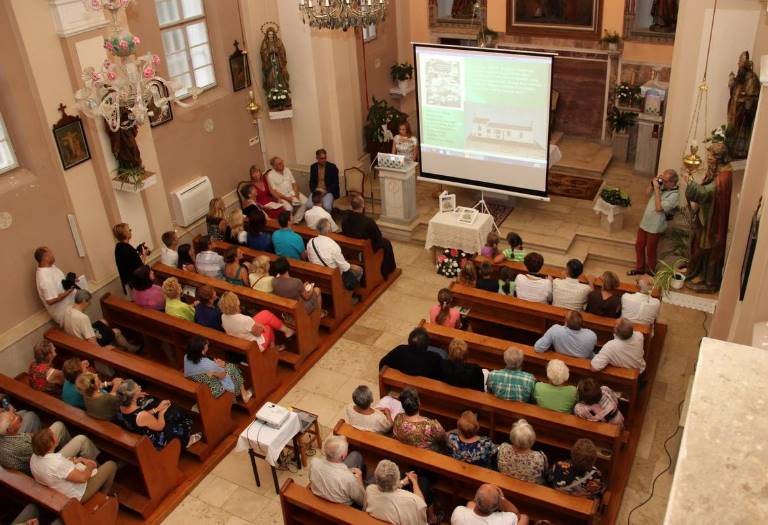
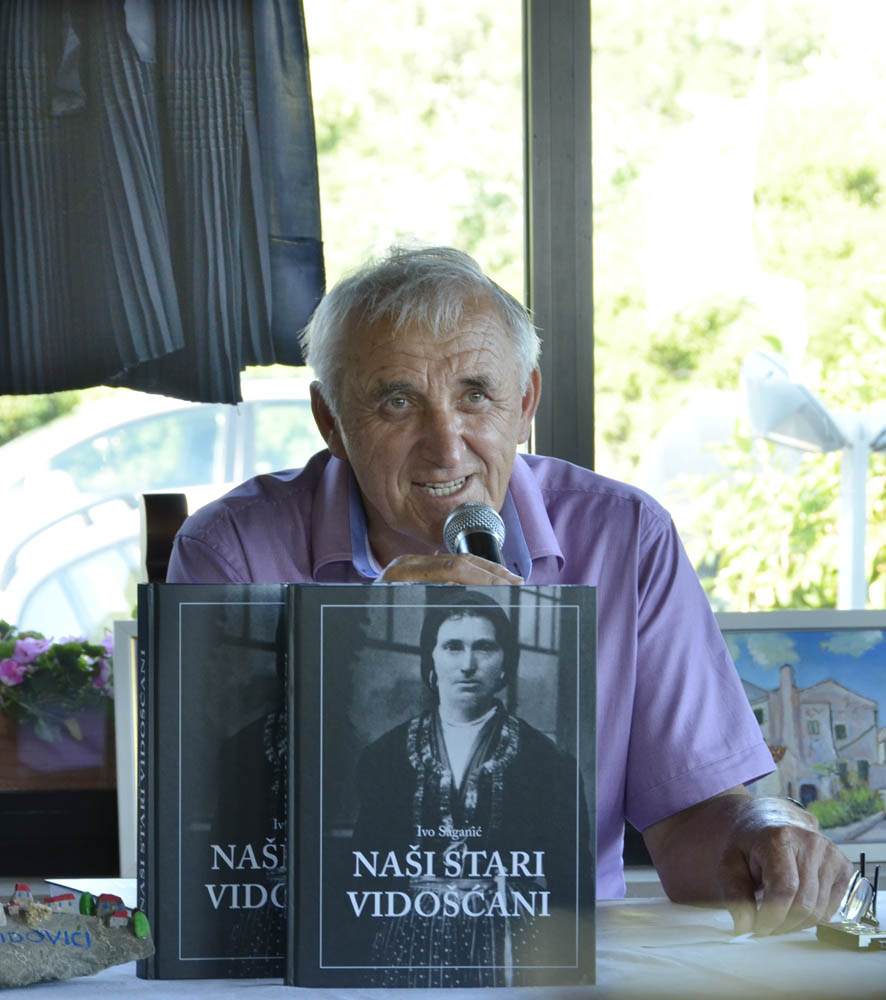
Last July (2016) the book had a grand launch with a book signing in Martinšcica. The event was well
attend with over two hundred people. It was held on the terrace of the hotel "Golden Lion". The folklore
group Orlec preformed. Talks were given by Dr. Julijano Sokolic and Bernard Balon. Balon is editor of
Zavicajne biblioteke Katedre Cakavskog sabora Cres-Lošinj (Native libraries Chair of Chakavian Assembly
for Cres-Lošinj), and Sokolic is a journalist and president of the local Katedre Cakavskog sabora
(Chakavian Council) who has written many books on the history and tourism on the island of Lošinj,
including the towns of Mali Lošinj, Veli Lošinj, and Nerezine. Also in attendace were Ivo Saganic's
aunt Dora Kucic, age 90, and Gino Kucic Gaspicev, the remaining two indigenous villagers of Vidovici.
Reference and photographs from:
Vidovici dobili enciklopediju iz pera kapetana Saganica, by Bojan Puric, July 10 2016.
Ilovik i Sveti Petar (Ilovik and Saint Peter's)
Unlike Saganic, who wrote his book in the Cakavian idiom, Pavokovic chose to write her book
in standard Croatian. Pavokovic's book is well illustrated with photographs of the people,
the buildings of Ilovik, including the monastary, and the antique household artifacts used on
the island in the previous century.
The full title of this book is Ilovik i Sveti Petar: dva otoka istoga imeni - na jednome se živi,
na drugome vjecno pociva (Ilovik and Saint Peter: two island with the same name - on one you live,
on the other you rest). There are two islands making up one settlement. Ilovik is the island where the
village is found, and Saint Peter's is the ajoining island with it's cemetery. The cemetery is one of
several featured in the book Kvarner Cemeteries and described in the last issue of this online
newsletter (No.25 - 2016).
The grave stones on Saint Peter's have been transcribed in Kvarner Cemeteries.
A narrow channel separates the two islands, so in order to bury an individiual, a boat is used to
take the body from the village to the cemtery, therefore the peculiar subtitle of the book.
Gordana was born in Rijeka, Croatia and studied sanitary engineering at the local medical faculty at
the university. She also receive a Ph.D. in biomedicine and health care from the Medical Faculty in
Rijeka, Croatia. Gordana as a naturalist is concerned with the conservation of biology. One of the co-authors of the
book deals with the issue of illegal poisoning of wild animals and of sheep breeding and the production
of Ilovik's sheeps cheese. Gordana is also engaged in photography, especially that of animals.
She spends her time between Rijeka and Ilovik with her husband Ladislav Radoslovic and daughter Ivna.
Pavokovic describes her book through the eyes of the people on Ilovik, "I saw that their [the islanders]
history is very long; there is a continuity of life on the islands for more than two millennia;
they are here throughout history between alternating powers and different empires and states,
and that these islands on the Croatian and eastern Adriatic coast are anything but historically
insignificant".
The first dozen chapters of Pavokovic's book are short and cover Ilovik's history from ancient times
to the 19th Century, and includes the Middle Ages, the Venician period, and the 18th, 19th and 20th
centuries. Other historical chapters round out the coverage with more recent events such as the
aftermath following the Second World War. Additional chapters touch on the lives of Ilovik residents from
the 19th Century up to today. Biographical details on some of the inhabitants of Ilovik over
the last two hundred years, including those that emmigrated from the island since the 1960's.
The book is full of biographical and genealogical information. For example, two generations of the
Karmelo Budinich describes their worked on Suez Canal in Egypt. There are
ten pages devoted to Ivan Radoslovic (1879-1975) and his family. Ivan came to the island to work as
a teacher at the island school, at the turn of the 19th Century. Ivan's orgins were in the Matesinich
clan from Unije and Mali Lošinj dating back to the 18th Century.
Separate chapters describe the islands olive oil, vinyards, fishing,
and sheep raising, all basic food resources employed on the island. These additional chapters make
for interesting reading on the local horiculture. Some of the chapters are summarized
below using the original Croatian chapter titles followed by an English translation.
Gordana Pavokovic launched her book, last summer during the community of Ilovik's "Dan Iseljenkia"
or Immigrant's Day.
The program began with the presentation of Gordana's book for visitors at the parish church.
An addressed was given by historian Julijano Sokolic who wrote the foreword for the book, and by
Mary Metz who made the prepress for the book. Reverend Milivoj Guszak and Mali Lošinj, Mayor Gari Cappelli
were also on hand for the occassion. The square in front of the church was used for a preformance by
the folklore society, Manfrina. Several expatriates and visitors were there to celebrate this
first "Dan Iseljenkia" in thirty years and to round out the cultural and entertainment program
for the evening.
The book is sponsored by the Croatian Heritage Foundation - Rijeka, Mali Lošinj, the town of Ilovik,
the City Library of Mali Lošinj and the Tourist Board of Mali Lošinj.
The book is written entirely in Croatian and consists of 283 pages published by Gradska knjiznica i
citaonica Mali Lošinj (Mali Lošinj Town Library and Reading Room). In 2016 it had been sold at
the Library, but all copies have now been distributed. More copies may be printed in the future.
The book presentation at Ilovik parish church
Reference and photographs from:
ODRŽAN DAN ISELJENIKA NA ILOVIKU 25.07.2016.
features Marija Saganic (1882-1925),
Ivo Saganic's grandmother.
House No.
Surname
Family Name
Oldest Individual
Dates
1
Saganic
Peritovi
Anton Saganic
1881-1964
2
Saganic
Matovi
Dinko Saganic
1835-1918
3
Saganic
Jakovjevi
Jakov Saganic
1871-1945
4
Saganic
Bravarovi/Franovi
Ivan Saganic
1789-1849
5
Saganic
Bravarovi
Ivan Saganic
1851-1899
6
Saganic
Preturovi
Dinko Saganic
1837-1873
7
Saganic
Saganicevi
Matija Saganic
1750-
8
Balon
Ivicevi/Blažovi
Bernardo Balon
1758-1836
9
Kucic
Anticevi
Anton Balon
1787-1875
10
Kucic
Kumpiri
Anton Kucic
1815-1905
11
Kucic
Mortovi
Damijan, Kucic
1800-1876
12
Kucic
Toninini
Mikula Kucic
1796-1865
13
Kucic
Gašpicevi
Ivan Kucic
1769-1850
14
Kucic
Memicevi
Dinko Kucic
1857-1942
15
Kucic
Principi/Dumijanjevi
Ivana Juranic
1759-1831
16
Kucic
Pašameti
Ivan Kucic
1835-1917
17
Kucic
Perovi
Mikula Kucic
1796-1865
18
Kucic
Karlovi
Dume Jurjako
1859-1905
19
Kucic
Ive Gašpicev
Ivan Kucic
1908-1998
20
Kucic
Gašpe Gašpicev
Gaspar Kucic
1911-2006
21
Kucic
Tone Principov
Anton Kucic
1917-1993
22
Kucic
Antonjevi
Antun Kucic
1809-1905
23
Kucic
Coticevi
Antun Kucic
1815-1905
24
Saganic
Capaftic/Pekovi
Andrea Saganic
1857-1920
25
Stefanic
Skopcarovi
Andrija Stefanic
1809-1881
26
Stefanic
Ivankini
Ivan Stefanic
1781-1856
27
Stefanic
Tone Ivankin
Anton Stefanic
1853-1902
Martinšcica 6
51556 Martinšcica
Croatia
e-mail saganic.martinscica@vip.hr
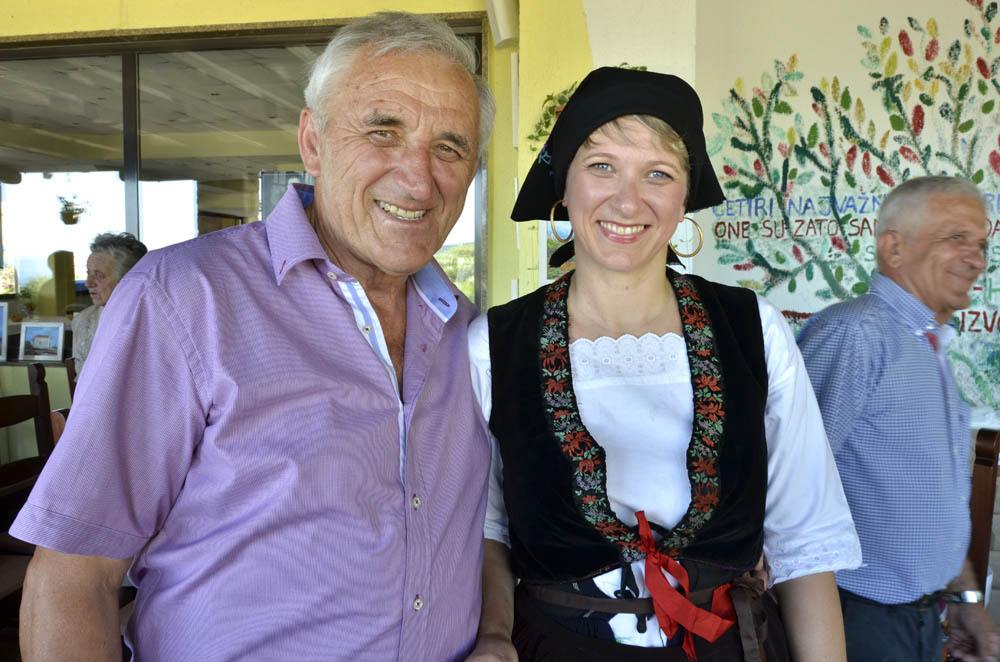
Ivo Saganic and daughter at the book launch
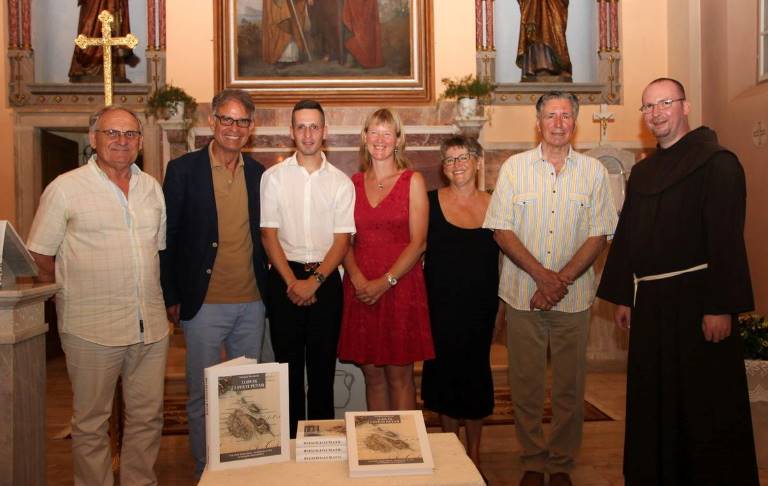 Gordana Pavokovic at the book launch
Original Chapter Headings
English chapter translations
Župna crkva sv. Petra i Pavla na Iloviku
The parish church of St. Peter and Paul on Ilovik
Procesije na Iloviku
(Religious) Processions on Ilovik
Posljednja plovidba Ilovcana
The last voyage of the residents of Ilovik
Skola na Iloviku
The school on Ilovik
Ilovik i Sveti Petar u 20. stoljecu
Ilovik and Saint Peter in the 20th century
Svakodnevni život Ilovcana pocetkam 20. stoljeca
Everyday residential life on Ilovik during the early 20th century
Prica o djetinjstvu Ilovcana Karmela Budinica u Port Saidu
The story of Ilovik childhood resident - Carmelo Budinich in Port Said
Predmeti za svakodnevnu uporabu pocetkom 20. stoljeca
Items for daily use at the beginning of the 20th century
Ilovik nakon Drugog svijetskog rata
Ilovik after the Second World War
Struja na Iloviku
Electricity on Ilovik
Franjevci na Svetom Petru
The Franciscans on St. Peter's
Uredenje franjevackog odmarališta nije bio jednostavan zadatak
The interior of the Franciscan island (Saint Peter's)
Zavjetni dar nakon trovanja
Votive offerings
Životni put covjeka koji oslikava težak život Ilovcana u razdobljima siromaštva i rata
The hard life of Ilovik residents during periods of poverty and war
Djelatnosti na Iloviku
(Photos of everyday) Activities on Ilovik
Poljoprivreda na Iloviku i Svetom Petru
Agriculture on Ilovik and Saint Peter's
Masline na Iloviku i Svetom Petru
Olives on Ilovik and Saint Peter's
Predmet iz stare uljare za masline i za maslinik
The subject of the old olive mill and olive groves
Kako su se nekada mljele masline?
How were olives once pressed?
Vinogradi na Iloviku i Svetom Petru
Vineyards on Ilovik and Saint Peter's
Ribarstvo na Iloviku i Svetom Petru
Fishing on Ilovik and Saint Peter's
Lov ribe dinamitom
Fishing with dynamite
Ribarska radna zadruga Naprijed
"Forward" the Fishermen's cooperative
Ovcarstvo na Iloviku
Sheep herding on Ilovik
Kako se danas drže ovce na Iloviku?
How are sheep kept today on Ilovik?
Ilovacki ovcji sir
Ilovik sheep cheese
Prerada vune na otoku Iloviku
Processing of wool on the island of Ilovik
Turizam na Iloviku i Svetom Petru
Tourism on Ilovik and Saint Peter's
Izvori vode na Iloviku i Svetom Petru
Sources of water on Ilovik and Saint Peter's
Iseljavanje s Ilovika nakom Drugog svjetskog rata
Emigration from Ilovik after The Second World War
Legalni egzodus
Legal exodus
O dugovjecnosti Ilovcana
The longevity of the residents of Ilovik
Vjetrovi
Winds
Biljeska o autorici
Notes on the author
Literatura
Bibliography